Main Article Headline |
Two Coochie Families Raising Their Kids |
“Morning, Mavis. How are the kids?”
“Still alive, Colin. One’s hiding in the grass, one’s wandering towards the road, and the third thinks freezing beside a car tyre makes him invisible.”
“Sounds familiar,” sighed Colin the Bush Stone-curlew. “Ours has been pretending to be a stick since sunrise.”
Breeding season can be a nerve-racking time for Coochie’s ground-nesting birds.
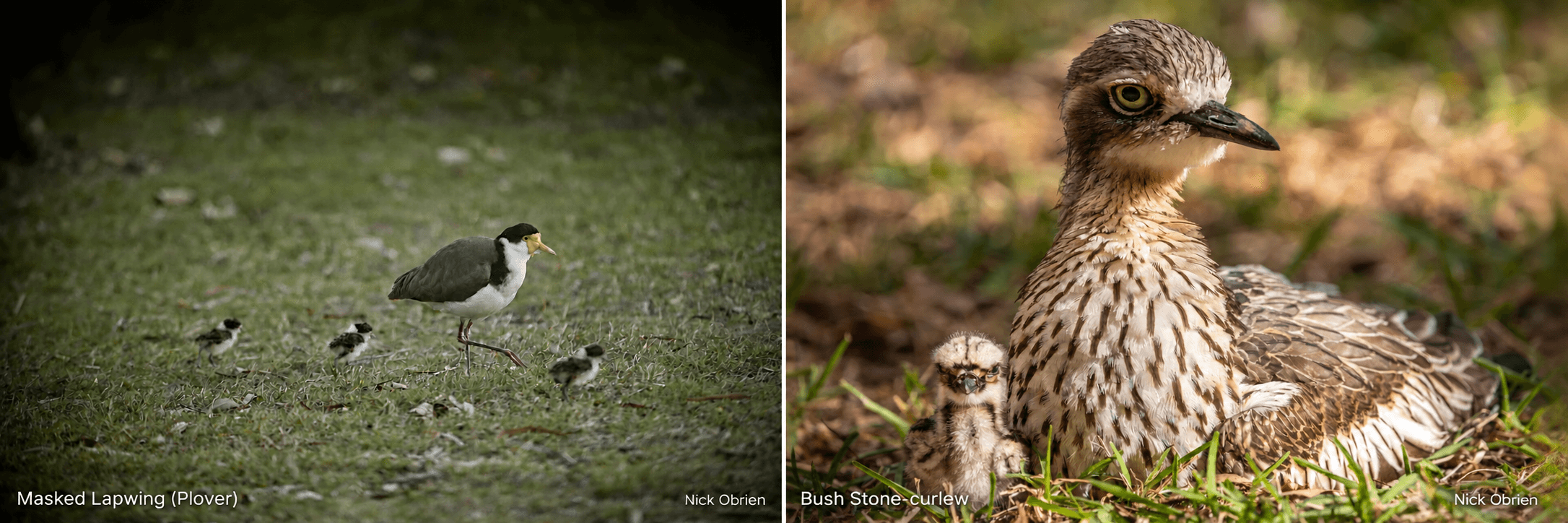
Masked Lapwings, commonly called plovers, and Bush Stone-curlews raise their families right under our noses.
They nest on lawns, beside roads, near driveways and in other places that look completely unsuitable to us.
To them, it’s home
The plovers choose an open-plan nursery Masked Lapwings make a simple scrape directly on the ground, usually in an open area where they can see trouble coming. Both parents help incubate the eggs and care for their chicks.
Within hours of hatching, the fluffy youngsters can leave the nest and begin feeding themselves. They’re tiny, mobile and apparently born with absolutely no sense of danger.
When something comes too close, the parents sound the alarm. They may swoop, spread their wings or pretend to be injured in an attempt to lure the threat away from their babies.
“People call me aggressive,” Mavis complained. “I’ve got several toddlers, no fence and kookaburras watching from the trees. Of course I’m yelling.” Although a swooping plover can be intimidating, it is usually trying to frighten the intruder away rather than make contact.
The curlews prefer the disappearing actBush Stone-curlews take a quieter approach.
They nest on the ground and rely heavily on camouflage. When danger approaches, adults and chicks may freeze completely, hoping they blend into the grass, leaves and shadows.
It’s remarkably effective until someone drives past, walks too close or lets an excited dog investigate the strange feathery “stick.”
“We don’t swoop,” Colin explained. “We stand perfectly still and stare. Very intensely.”
Curlews are most active after dark, which is when their haunting calls travel across the island. Those calls may sound mysterious to us, but some are warnings, contact calls or family conversations. Quite possibly including: “Where are you?” and “I told you not to wander off.”
It’s a dangerous neighbourhoodwhen you’re very small
Both families face natural predators, including snakes, kookaburras and other birds or animals capable of taking eggs and chicks.
Domestic pets can also pose a danger, particularly when they roam near nesting and feeding areas.
Cars add another serious risk because frightened chicks may run unpredictably, crouch on the road or freeze instead of moving away.
The parents do everything they can, but there’s only so much you can do when your children are the size of tennis balls and convinced they’re bulletproof.
How we can be good neighboursA few simple choices can make an enormous difference:
All native birds are protected in Queensland, and interfering with an active breeding place may require official approval. (Sidebar...oh, the irony of this statement after the welcome swallow debacle!) (environment.qld.gov.au)
Usually, the kindest thing we can do is pause, notice and give the family room.
After all, Mavis and Colin are simply doing what Coochie parents have always done: raising the kids, warning the neighbours and hoping everyone makes it safely through another day.
“Snake!” called Mavis. “Kookaburra!” warned Colin. “Car!” they both shouted.
And somewhere nearby, several small fluffy chickies completely ignored them. |
0 Comments
Join the conversation
Be the first to comment
Share your thoughts above.