
Island Skies and Mainland Plans: |
What Package 3 Changed and What Package 4 Will Examine
|
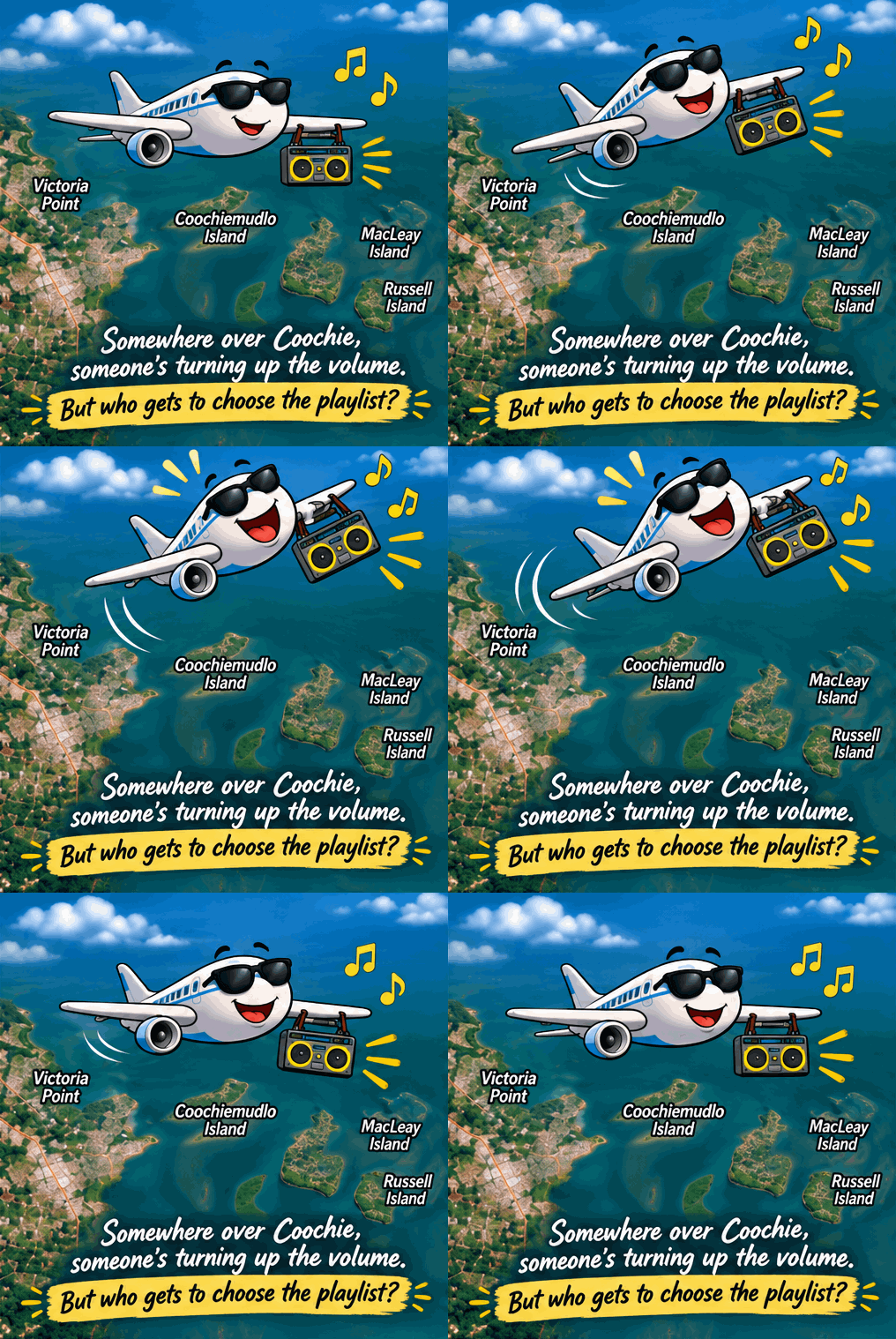
Package 3’s outcomes are final. A separate, broader Package 4 consultation is now open.
TL;DR: Package 3 assessed changes within Brisbane’s existing airspace design. Some arrival-path changes took effect in July 2026; other outcomes still need further work.
Package 4 is a separate investigation into wider airspace options, including noise sharing and respite. Feedback is open until 13 December.
If you’ve lived on Coochiemudlo for any length of time, you develop a pretty intimate relationship with the ambient soundscape. You learn the rhythm of the tides, the put-put of the Meg or Serena crossing the bay, the clank of the ferry ramp, the rustle of the she-oaks, and the bubbling “whoop” of the Pheasant Coucal. So when aircraft noise comes up, it’s natural to wonder what’s changing above our corner of Moreton Bay. There are two parts to this story, and they’re easy to muddle. Package 3 and Package 4 are separate pieces of work within Airservices Australia’s Noise Action Plan for Brisbane.
Package 3’s outcomes have been published. Package 4 is a new consultation about broader options for the Brisbane and South East Queensland airspace.
And yes, the labels are a bit clunky. “Package” refers to a workstream; “phase” refers to a round of consultation.
What did Package 3 do?Package 3 examined options to reduce the frequency and concentration of flights over communities, within the constraints of the existing airspace design.
Airservices published its final Package 3 outcomes in July 2026. Some arrival flight paths over land into Brisbane Airport changed on 9 July.
Other outcomes are still progressing through detailed design, safety work and environmental assessment. The use of Independent Parallel Runway Operations (IPRO), where aircraft can arrive on both runways at the same time, is expected to begin in the middle to later part of 2027.
So it would be too simple to say Package 3 was only about “moving flights over water” or only about airport capacity. The outcomes include different changes to arrivals and departures, with Airservices saying its assessments considered factors including population overflown, noise, frequency, cumulative impact and aircraft altitude.
The published outcomes are final. That doesn’t mean residents can’t report what they’re experiencing; it means the Package 3 decisions themselves are not being reopened through this consultation.
What is Package 4, then?Package 4 is not another name for the July changes, and it isn’t a new phase of feedback on Package 3.
It looks at larger, longer-term opportunities beyond the constraints of the existing Brisbane airspace design. The review also covers the wider South East Queensland airspace. Options under consideration include different runway modes, respite routes and ways to share noise between communities.
The Package 4 consultation is open from 9 November to 13 December 2026. No decisions have been made on the options under consideration. Airservices is asking people to review the information and provide feedback while the options are being assessed.
There are in-person drop-in sessions around Brisbane and online Q&A sessions with Airservices and Trax International. The session details and booking information are here.
The closest in-person session to Coochie is at Cannon Hill on Monday 30 November. What does this mean for Coochie?Coochiemudlo sits just off Victoria Point, near the southern part of the broader airspace being considered. That makes it reasonable for islanders to pay attention. It doesn’t, by itself, prove that a particular flight path has changed over the island or that aircraft noise has increased.
The useful question is what the evidence shows over time: which routes are being used, how often, at what altitudes, and under what conditions. WebTrak can help you look at aircraft movements, tracks and altitudes. Noise readings come from specific monitors, though, so it won’t give a measured decibel reading for every flight over Coochie.
If you notice a change, make a record of the date, time, weather and what you observed. Airservices says its Noise Complaints and Information Service records and reviews complaints to identify possible improvements.
There’s no need to claim that an unreported event “legally didn’t happen”; the practical point is that a report gives Airservices information to review.
Who can islanders talk to?The Brisbane Flight Path Community Alliance brings together communities affected by Brisbane Airport’s flight paths and advocates for changes to reduce noise impacts. RADAR, organised through the Federal Member for Bowman’s office, shares Redlands-focused updates and advocacy opportunities.
On Coochie, the Coochiemudlo Island Progress Association is the local residents’ body that liaises with government. CIPA describes itself as apolitical. I haven’t found a public CIPA position on aircraft noise, so it’s best to treat it as a local place to raise the issue rather than assume it has joined a particular campaign.
Package 3 tells us what changes Airservices has decided to progress.
Package 4 asks what broader options should be considered next.
Keeping those two things separate makes it easier to understand what’s settled, what’s still open, and where Coochie’s observations may fit.
Have you noticed a change in aircraft noise or flight patterns over the island since July?
Keep a note of what you hear and see, and consider sharing it through the relevant Airservices channel or raising it with the local community or Coochie Progress.
Useful links: Package 3 outcomes · Package 4 consultation and sessions · Brisbane WebTrak
While my AI buddy has been a fabulous help in distilling this information, I encourage you to check it out for yourself, contact/join the relevant groups (see above) and have your say! |
0 Comments
Join the conversation
Be the first to comment
Share your thoughts above.