The RFDS Medical Chest |
Unlocking the Lifesaving Secrets Inside the RFDS Medical Chest - Discover the essential tools saving lives in remote Australia. |
TL:DRCoochiemudlo Island has access to a Royal Flying Doctor Service medical chest because the island is officially classified as a remote community due to limited after-hours access to mainland medical services.
The chest contains a range of prescription medications, including antibiotics, inhalers, children’s medicines and emergency treatments, which can only be accessed after an assessment by an RFDS doctor. One island resident shared how the service helped treat her suspected pneumonia over a long weekend, with medication delivered within 40 minutes after a video consultation with an RFDS doctor, potentially preventing a hospital trip.
The service is run locally by a team of trained volunteers, who don’t need medical backgrounds but do follow strict procedures and confidentiality rules. The biggest surprise? Everyone interviewed said the same thing: It’s much easier, faster and more accessible than people realise. |
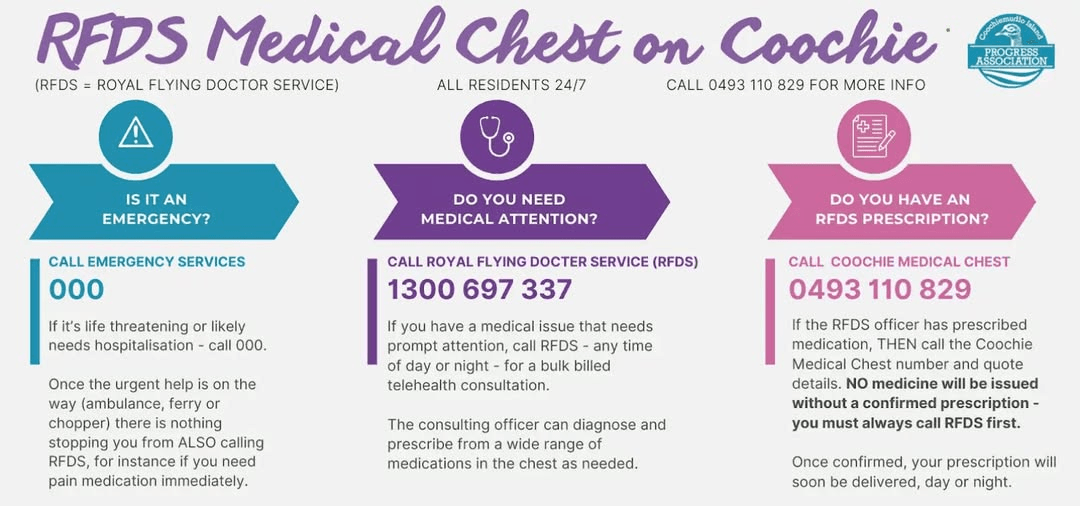
⚕️💊Phone numbers below 👇 Most people know the Royal Flying Doctor Service of Australia exists.
Far fewer realise there’s a secure medical chest sitting quietly on Coochiemudlo Island that can connect residents directly to an RFDS doctor and, in some cases, prevent a frightening medical situation from becoming a full-blown emergency.
And here’s the surprising part. The chest is not some dusty relic from the old outback radio days. It’s active. It’s modern. It’s used.
And for one island resident recently battling pneumonia over a long weekend, it likely stopped a rapid downhill slide that would otherwise have ended in hospital.
What emerged during conversations with the chest custodian and a patient who used the service wasn’t just a story about medication. It was a story about isolation, community resilience, volunteers, late-night fear, and the strange comfort of knowing help is closer than you thought.
“We Are Classified As Remote”
That surprises a lot of people. After all, Coochie is only an eight-minute ferry ride from the mainland. But as medical chest custodian Julie explained, the classification comes down to one important factor: access.
“We don’t have 24-hour access to mainland services,” she explained. “At night, we are isolated.”
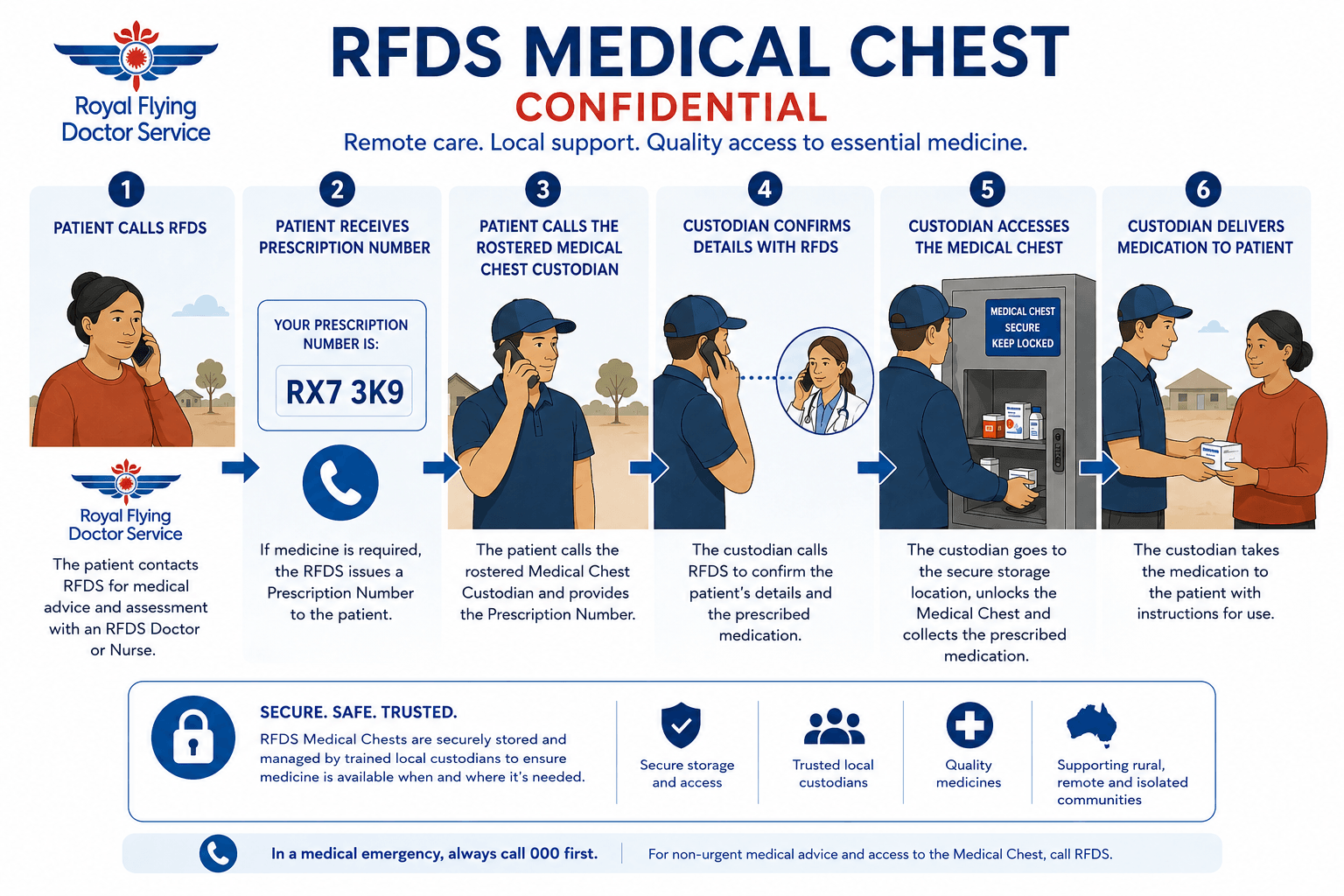
That isolation qualifies the island for access to an RFDS medical chest, a locked and carefully controlled supply of medications that can only be accessed under instruction from an RFDS doctor. Inside are prescription medications including:
There’s even a refrigerated section storing medications that must stay cold.
What there isn’t, Julie stresses, is casual access. The chest remains locked in a secure location and can only be opened by authorised volunteers following strict protocols. “This is a doctor’s assessment,” Julie said. “It’s not just ringing up and getting medication.”
The Moment It Became RealFor island resident Menka, the service became very real very quickly. She’d been sick for days over the Easter long weekend and was getting worse, not better.
By Tuesday evening, she’d managed to get a telehealth appointment with her mainland GP, but physically getting to a chemist before closing time was becoming impossible.
“I was quite sick,” she said simply. So she called the RFDS. What followed surprised her. “The doctor was so good,” she said. “He stayed on the phone with me for about 15 or 20 minutes.”
When the doctor became concerned about how breathless she was, the consultation escalated into a WhatsApp video call so he could visually assess her condition. At one point, she became puffed simply walking from the couch to the bathroom. “He said, ‘I think you have pneumonia.’”
The doctor prescribed medication through the RFDS chest system, instructed her on how to monitor her condition, and advised her to call an ambulance if things deteriorated.
Within about 40 minutes, the medication had arrived on the island. “It was so much quicker than trying to get to the mainland,” Menka said. That night, things worsened dramatically.
The puffer prescribed through the service likely prevented an emergency hospital transfer. “If I didn’t have that,” she said, “I would have had to go to hospital.”
Not Just EmergenciesOne of the biggest misconceptions about the medical chest is that it’s only for catastrophic emergencies. It isn’t. The service exists in that important middle ground between:
If someone is experiencing worsening symptoms, is too unwell to travel, is isolated overnight, or needs urgent medical advice when normal services are unavailable, the RFDS can assess the situation directly.
And importantly, the doctors don’t just hand out medication automatically. “They’ll go through your history, assess your condition and work out what’s needed,” Julie explained. If an ambulance is required, they’ll say so. If someone can safely remain at home with treatment and monitoring, they’ll guide that too.
It’s essentially telehealth with immediate local access to critical medications.
And for island families, that matters. Particularly on weekends.
The Quiet Volunteers Behind ItThe system itself is only possible because of volunteers. Currently, around 14 active volunteers rotate responsibility for the phone and chest access via a roster system designed specifically for the island.
Volunteers don’t need a medical background. They complete:
The medications themselves are organised by number rather than name to avoid mistakes during stressful situations.
“The doctor might say, ‘You need box 170,’” Julie explained. “So there’s no confusion.”
The volunteers are not diagnosing people. They are facilitating access safely, quickly and confidentially.
And confidentiality is taken seriously. “You do not go around the island saying who you visited and what they needed,” Julie said firmly.
That level of trust matters in a small community where everybody knows everybody.
“It Was So Easy”Both women kept returning to the same phrase. “It was easy.” Not careless. Just straightforward.
For a system many people assume would be complicated, bureaucratic or difficult, the reality appears surprisingly practical.
“You’re straight through to a doctor,” Julie explained.
And for Menka, that simplicity mattered enormously.
“It sounds more complicated than it is,” she said. “But once you understand the process, it’s quick, easy, and you’re getting help in your own home.”
That may be the real story here. Not just the medications. Not even the chest itself.
But the fact that in a small island community often described as “isolated,” there exists a quietly functioning network of:
…that can move remarkably fast when somebody needs help. Or as one of the women joked when asked what the medical chest would say if it could speak: “I’m here to help. Please use me.”
|
 |
0 Comments
Join the conversation
Be the first to comment
Share your thoughts above.