Coochie’s Wild Side |
Snakes, Frogs and Other Quiet Neighbours |
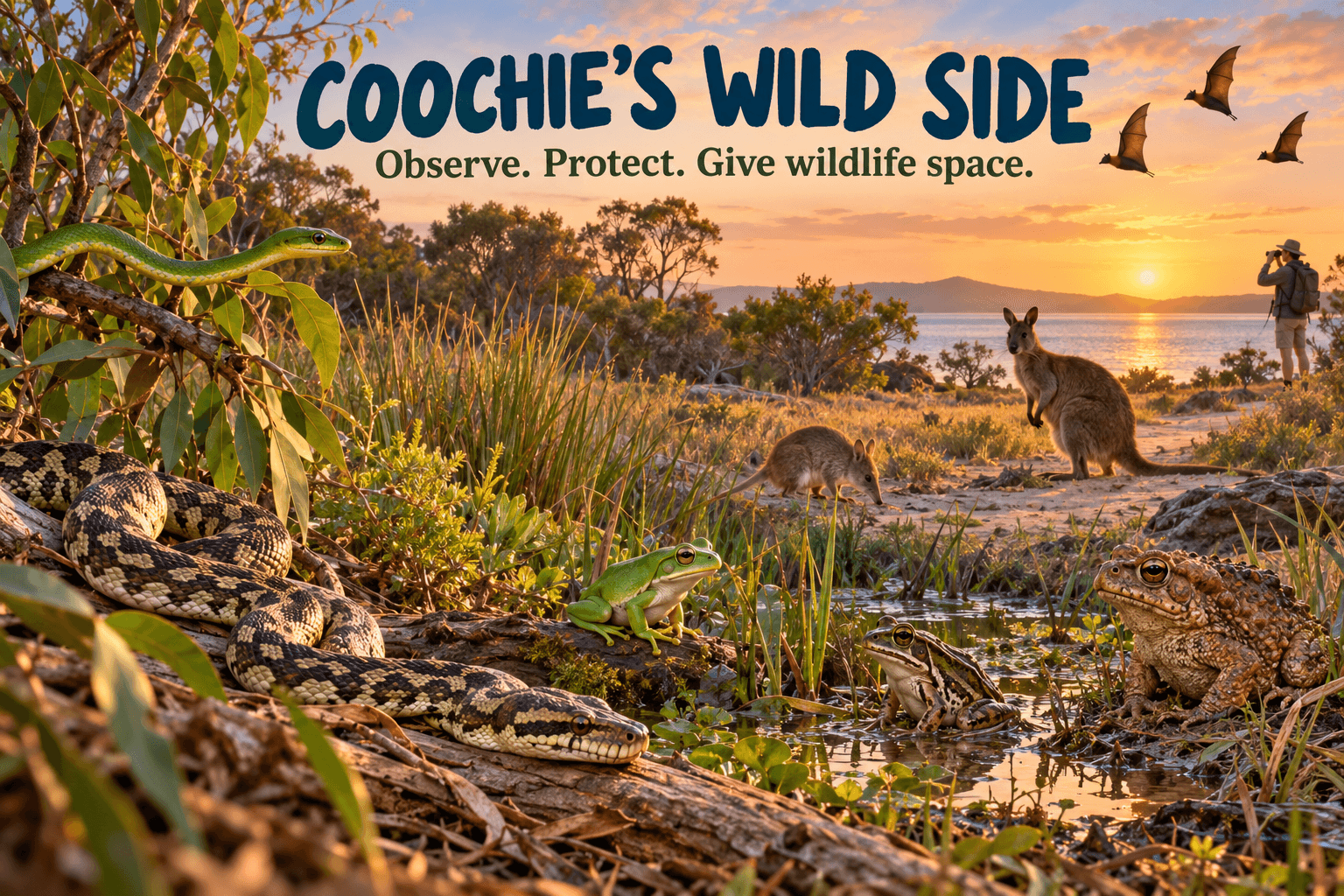
We You can live on Coochie for years and still have no idea who is living quietly beneath the leaf litter, inside a hollow tree or flitting above your roof after dark.
A year-long fauna survey of the Melaleuca Wetlands gives us a fascinating glimpse into that hidden community. Researchers visited during all four seasons in 2016, using wildlife cameras, traps, nocturnal searches and acoustic recordings. Read the report here.
It was an unusually dry year, so the survey is best viewed as a snapshot rather than a complete rollcall. Even so, what they found might make you look at Coochie a little differently on your next walk. Snakes: which ones can we pet?
None of them.
Sorry. I know that ruins the headline.
Coochie has an impressive collection of snakes for such a small island. The survey and earlier local records include:
The carpet python, green tree snake, keelback and blind snake are generally not considered dangerous to people. The little blind snake is particularly unthreatening and spends much of its time underground eating ant and termite larvae.
That does not make any of them suitable for a cuddle.
Even a non-venomous snake may bite when frightened, cornered or handled. If you see one outside, give it space, bring children and pets indoors and let it continue on its way. Most snakes are looking for an exit, not an argument.
The snakes requiring much greater caution include the eastern small-eyed snake and death adder. Both are dangerously venomous. Yellow-faced whip snakes are venomous too and can deliver a painful bite, although serious effects are uncommon. Death adders deserve particular respect because they rely on camouflage rather than racing away.
A person could come surprisingly close without seeing one. This is an excellent reason to wear enclosed shoes, use a torch at night and avoid reaching blindly into garden beds, piles of timber or dense groundcover.
The safest rule is beautifully simple: do not try to identify a snake by getting closer to it.
If a snake enters your house or settles somewhere around the yard where it presents a risk, keep your distance and call a snake catcher.
Please do not attempt to catch, corner or kill it. All native snakes are protected wildlife, and trying to interfere with one is when many bites occur.
If someone is bittenTreat every suspected snake bite as a medical emergency, even if the person feels well and even if you think the snake was harmless.
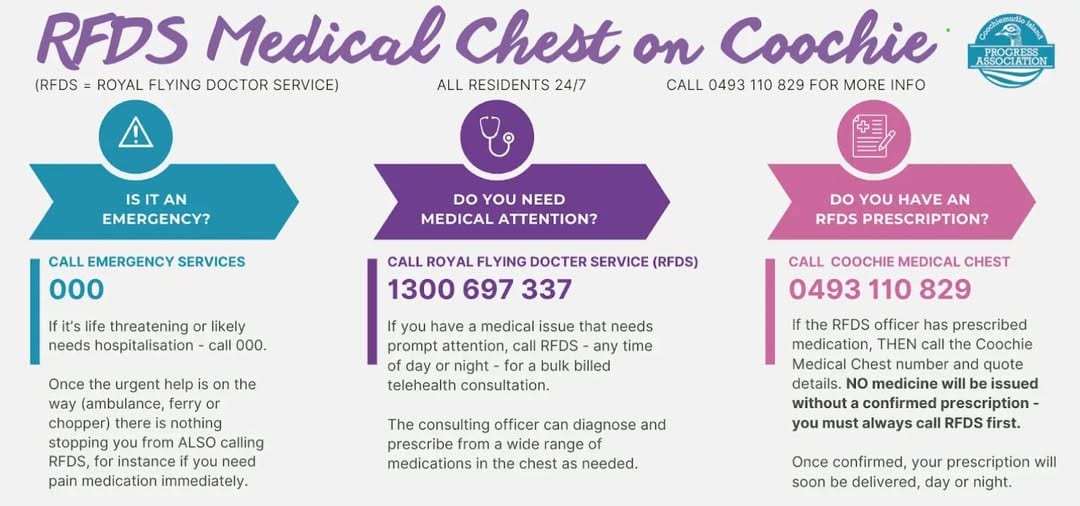
On an island, having pressure-immobilisation bandages in an accessible first-aid kit makes very good sense. You can also call the RFDS Medical Chest AFTER you have called 000 if you need supplies (see image below for details) Queensland’s Poisons Information Centre provides illustrated instructions for correctly bandaging a snake bite.
Frog or toad? Please check before declaring war.
The survey detected two native frog species in the wetlands: the striped marsh frog and eastern sedge frog. Residents also reported green tree frogs, although none were recorded during the formal survey.
Then there was the unwanted visitor: the cane toad.
Native frogs and cane toads are both amphibians, so the difference is not always as simple as “smooth frog, warty toad.” Generally, an adult cane toad has dry, leathery, warty skin; pronounced ridges above the eyes; and large poison glands behind the head.
Native frogs are often smoother, moister and more lightly built.
But young cane toads can be confused with native frogs. If you are uncertain, photograph the animal and check its identity before doing anything.
The Australian Museum’s FrogID app can help.
Cane toad tadpoles are small and uniformly black, while native frog tadpoles are generally lighter underneath and display more variation. Again, identification matters. We don’t want an enthusiastic toad campaign accidentally wiping out the very frogs we’re trying to protect.
Why remove cane toads?
Cane toads are poisonous at every stage of their life cycle, including eggs and tadpoles.
They can poison wildlife and domestic animals that attempt to eat them. They also consume small reptiles, insects and other amphibians, compete with native animals for food and breeding habitat, and can affect native frog tadpoles.
On a small island, coordinated control has real potential to make a difference. Removing adult toads is useful, but reducing breeding opportunities is just as important.
Around the home, that means:
Any removal and euthanasia method should be humane and consistent with current animal-welfare advice.
And once again, be certain that it really is a cane toad before taking action. A native frog should not pay the price for a case of mistaken identity.
The mammals that appear after we go inside
The wetlands survey detected far more mammal activity overhead than on the ground.
Bats were the most abundant mammals recorded. Flying foxes used the island throughout the year and formed a winter camp not far from the wetlands. Microbats were regularly seen at dusk, while acoustic equipment identified six definite species and another two possible species from their calls.
Northern brown bandicoots were also recorded. They are shy, mostly nocturnal animals, so their small conical holes in lawns and soft soil may be noticed more often than the animals themselves.
Swamp wallabies have been seen around the wetlands and grazing near the Laurie Burns Reserve oval at dawn. One resident also photographed an echidna on the island after the survey finished.
Koalas reportedly lived on Coochie several decades ago, although the survey found no evidence of a current population.
Possums have also been reported historically but remain unconfirmed. Here’s the slightly eerie part: after 480 trap-nights, researchers detected no native rodents or small terrestrial marsupials in the wetlands.
Whether they were genuinely absent or simply very scarce remains an open question.
How to meet the neighbours without disturbing them
The best wildlife watching often happens around dawn and dusk. Walk slowly, keep voices down and observe from a respectful distance.
A small torch with a red-light setting is useful after dark because it causes less disturbance.
Binoculars are even better, particularly if there is a wallaby, flying fox camp or nesting animal nearby.
Avoid feeding wildlife, touching animals or approaching young ones. Keep dogs leashed and cats safely contained, especially at night. The survey recorded unaccompanied dogs and cats in or near the wetlands and identified roaming pets as a threat to ground-dwelling wildlife.
If an animal changes its behaviour because you are there, you are probably too close. Step back and let it get on with its evening.
Coochie’s wildlife is not always obvious. Much of it waits until we turn off the mower, put away the tools and go inside.
Then the night shift clocks on.
|
 |
1 Comment
Join the conversation
I had no idea there were death adders on Coochie. Shoes on for evening walks!