Heritage Society AGM |
Unlocking historical secrets at the Heritage Society AGM: Discover the told and untold stories that shaped our community. |
Many Hands, One Island Story
David Paxton reflects on more than twenty years of the Coochiemudlo Island Heritage Society
If you’ve ever joined one of David Paxton’s historical walks, you’ll know he has a gift. What begins as a simple wander somehow becomes a journey through decades. Stories surface. Names connect. The island reveals itself layer by layer.
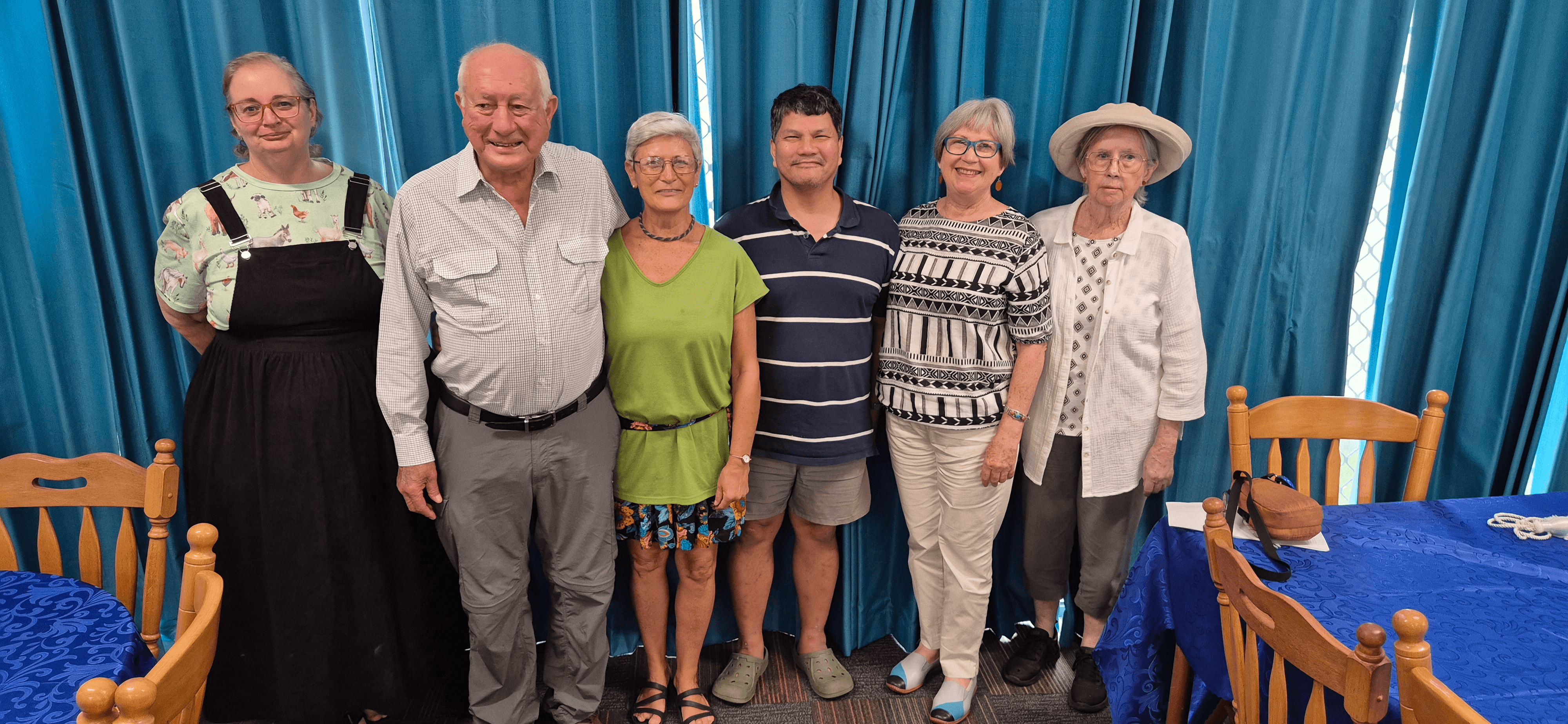
At the Coochiemudlo Island Heritage Society AGM on 22 February 2026, David delivered a warm, generous and often humorous reflection on more than twenty years of community effort. His central message was simple:
People doing things is a society. Many people doing many things makes history and underwrites heritage.
Before the SocietyDavid began by stepping back to the early 1990s, when Professor John Pearn published Chronicles of Coochiemudlo (1993), compiling stories of accomplished islanders including Ted Jones, Denise Foley, Maureen O’Connor, Rosemary Opala, Joan Bland and others. That book, followed by Characters, Coves and Cliffs (1995), helped spark a renewed interest in the island’s own story.
That groundwork mattered In 1999, Coochiemudlo took its place in the Bicentennial celebration of Matthew Flinders’ exploration of Moreton Bay. A large crowd gathered to see the replica Norfolk, built in Tasmania and commanded by Bern Cuthbertson, moored off the beach. Ted Jones re-enacted Flinders’ landing.
With boats everywhere and spectators lining the water, Ted briefly lost sight of the beach from the dinghy’s tiller. Tempers flared. A dignitary became bogged near the wetlands. Yet thanks to the capable management of Norma Green and Margaret Anderson, the day was a success.
Out of that momentum, the Historical Society was formed. According to Robyn Dixon, the genesis began with a handful of locals gathered around her father Neville’s coffee table, discussing the idea of bringing over a schoolhouse to house island memorabilia. Neville sadly passed away; his photograph now hangs in the History Room.
The first meeting of the Coochiemudlo Island Historical Society took place in 2000. It was kick-started by foundation and life memberships. Ted Jones became president, Ronnie James the first secretary, later replaced by Maureen O’Connor. John Pearn served as patron.
A list of donors and memorabilia was created. Items began piling up on Merle Beckett’s verandah. Merle later became president herself. The early ethos was clear: collect, preserve, catalogue. David and Ellen arrived on Coochiemudlo in June 2002. Soon after, he was persuaded by Elaine Fraser and Joy Fritz to take on the role of secretary.
His first meeting was memorable. Seated beside Merle in the room next to the library, he witnessed a back-lit figure appear in the doorway and shriek “like a banshee.” It was Judith McQueen, the Treasurer, demanding that her painstaking hours of work organising the Society’s books and affairs be taken seriously. It was, David said, quite an introduction.
Early Tensions and a History RoomWhen the Historical Society formed, the Progress Association had already been operating for thirty years. With Ted Jones as president of the new Society, some in Progress worried about a shift in influence. David, a member of both groups, inadvertently stirred things further by typing up a formal program for the Flinders Day re-enactment subcommittee. Formality was not common practice. He was accused of trying to take over the event and grilled at what he described as a kangaroo court.
At the next Progress meeting, Stan Harris (President) calmed the situation after Frank Green (Secretary) offered to take David outside and thump him. Bev and Don Holcroft stood up for David, Bev serving as coordinator of the Markets Committee.
Around this same period, Council discussions regarding the Surf Lifesavers’ proposed clubhouse created island-wide tension. Ray Burton was their president. Rumours circulated, community meetings polarised, and emotions ran high. Ultimately, Council allowed the Lifesavers to build on their designated block and, seeking fairness, offered to build the Society a room.
The proposed jetty-side display container never materialised, but the History Room under the Community Hall did.
Meanwhile, through the Consultative Committee convened by Kevin Childs with Margaret Anderson as secretary, Rob Friend and Associates produced a strong island development plan in 2004. Trim: The Dinghy That EnduredOne of the Society’s enduring symbols is the 15-foot dinghy used for the Flinders re-enactments. Originally inherited by TS Norfolk from the Girl Rangers, the dinghy had previously served on the Brisbane River. After sinking during one re-enactment, it was retired. Islanders temporarily borrowed Rob and Liz Virtue’s rowing skiff.
Eventually, TS Norfolk donated the original dinghy for restoration. Found upside down at the Moreton Bay Motor Boat Club and surviving a storm the night before collection, the vessel’s bloodwood keel and New Zealand kauri hull held firm. Restoration was led by boatwright Bruce Legg of Russell Island, who sheathed the clinker hull using twill cloth and resin. Peter Büechse spray-painted it grey. Keith Slack carved its nameplate: Trim. The Society later secured a Dunbier trailer to protect the hull during launching.
Trim was formally named by descendants of Matthew Flinders — Paul and Kate Flomersfeld and their sons Timothy and Christopher — whose family travelled from Adelaide for the occasion. The dinghy has appeared in Outback Spectacular promotional material and in a film by Tamara Whyte.
Today, Trim is housed in Annette Drennan’s carport. David acknowledged Annette’s long-standing support of the Society and remembered her late husband Bob, whose steady encouragement and practical support over many years were deeply appreciated.
Leadership and LegacyDavid paid tribute to notable presidents including:
David also recognised the ongoing work of Jo Comerford, Jan MacIntyre, and many committee members including Denise Preston, Daveen O’Pray, Keith Slack, Dennis and Margrit Lack, Brian Aitken MBE, Bruce Sowter, Vivienne and Graeme Roberts-Thomson, Yvonne and Andrew Symes, and many more whose contributions form the backbone of the Society.
Partnerships and RepresentationThe Society has worked with elected representatives including Jon English, Peter Dowling, Matt McEacham, Kim Richards, Cr Lance Hewlett, Cr John Burns, and mayors Don Seccombe, Melva Hobson, Karen Williams and Jos Mitchell.
It has partnered with Redland Museum, the Minjerrabah Museum, and the Quandamooka Yoolooburabee Aboriginal Corporation, including the formal handover of a stone mortar used to grind bungwhal fern roots, uncovered near Victoria Parade East.
The Society auspiced the founding of the Community Library and Coastcare and successfully secured a 2015 ANZAC Centenary Grant to upgrade the Doug and Mary Morton Reserve.
The Shift to HeritageIn 2014, following a Special General Meeting, the Society formally changed its name and objectives to include Heritage.
David offered this definition: Heritage is a community’s aspirations for the future, framed in the present, based on experience derived from the past. He encouraged the Society to remain proactive, particularly in adapting to climate change and exploring restoration projects such as visiting the reclaimed wetlands at the Port of Brisbane.He also reminded everyone that while preservation is vital, social connection matters just as much. “I love the vibes at our events,” he said. “The website is not a substitute for those vibes.”
A Poem for CoochiemudloDavid closed with a poem: Coochiemudlo After listening to David, one thing was unmistakable. Coochiemudlo’s heritage has not been built by one person or one committee. And that story continues.
|
0 Comments
Join the conversation
Be the first to comment
Share your thoughts above.